

I have a very vivid memory of the first time I remember coming face-to-face with rage. I was around twelve years old, and I had been dealt some kind of perceived injustice by my mom. I can’t remember the injustice, but I clearly remember my response, viciously slamming my bedroom door and dramatically sweeping everything off my desk onto the floor. Looking at the pile of things around my feet, I remember being flooded with fear, shame, and embarrassment about what I had just done. I don’t remember anything about the injustice or what happened next; I just vividly remember the moment of rage.
And it scared me.
We all have different experiences of anger in our lives, stories of how we’ve experienced it. Every family deals with anger and conflict differently, in both healthy and unhealthy ways. As kids, we develop strategies for dealing with our anger, often based on how our family dealt with it. Over time, we become experts at either repressing or expressing our anger in ways that don’t serve us. I didn’t have language for it then, but that moment taught me something many of us learn early, that our anger can feel bigger than we are, and therefore dangerous.
What’s your relationship with anger?
Culturally, anger is seen as something negative, especially for women. But anger is not something to be stuffed down or avoided. Our anger has a message for us if we can be vulnerable and brave enough to hear it. Our anger shows us what we deeply care about and what we want to protect.
Welcome and befriend it. Anger can be a powerful tool for change.
“Anger is a tool for change when it challenges us to become more of an expert on the self and less of an expert on others.” Harriet Lerner, The Dance of Anger.
I wish that 12-year old girl, standing there with broken pencils and books scattered at her feet, could have seen her anger as a gift, not something to be afraid of or feel shameful about, because anger has important information. Healthy anger can help you understand who you are and what you care about. It can point out systems and patterns, both personally and collectively, that you want to change. Unhealthy anger, wielded in venting and blaming, still points to something important, but puts us in the role of a powerless victim, and possibly disrespecting the boundaries of others. We need to develop skills with our anger to make use of its power.
However, the thought of letting in our anger can feel scary.
For many of us, the assertion of anger feels dangerous. It can trigger separation anxiety, or it can make us feel unloving or unlovable. Sometimes it can feel overwhelming or uncontrollable. We have to go slowly, with compassion, to learn how to build our capacity towards our anger and the anger of others. When we learn to listen to our anger, it can help us develop clear boundaries and strong convictions. It can guide us towards actions that are aligned, respectful, and true.
Getting to Know Your Anger
The most important first step you can take when developing skills with your anger, is to get to know it and welcome it with curiosity. Like all of our emotions, anger occurs on a spectrum, so when does your “soft” anger show up vs. your “ready for war” anger? What do they feel like in your body? What physical sensations show up? How do you tend to deal with your anger or the anger of others? Repress or Express? Fight or Flee? Fawn or Freeze? In this first step, there is absolutely nothing to fix or change, only something to notice.
Once you begin to get a clearer picture of how your anger manifests, begin to ask it what it needs. Here are some questions you might ask it:
What do I need at this moment that I’m not getting?
Has a boundary been violated?
Has my self-image been challenged?
Is there another emotion underneath that the anger might be masking, like fear?
Is there anything that needs to be done, or do I need to regulate and care for myself?
Too Much, Too Little, and a Third Way
In your exploration, you may find that you either have too much anger, or not enough. Without your anger, your boundaries may be repeatedly crossed. You may find it difficult to stand up for yourself or respond to life in ways that honor your values. When we repress or avoid our anger, we often believe we’re keeping the peace. But in reality, we may be trying to control others to feel safe, and in the process, we end up losing ourselves.
When our anger becomes overwhelming, our boundaries may become too rigid. We may express it so forcefully that we override the boundaries of others, damaging relationships and leaving ourselves only feeling more and more agitated instead of feeling relieved.
There is a third way.
When we begin to understand and work with our anger, not shove it aside or ignore it, something shifts. Our anger becomes a source of clarity. It can help us communicate more honestly and allow us to set healthier boundaries, while respecting the boundaries of others. Over time, it can help us act in ways that feel aligned with who we are.
It was revolutionary for me to learn that my anger wasn’t something to fear or fix. Instead, it was something to understand. When I began to listen to it instead of pushing it away, my anger began to feel less overwhelming. Not comfortable, but clarifying. Not something to push down, but something to harness.
From that clarity, I could begin to respond to my life differently, with clearer boundaries, more aligned choices, and a deeper respect for what I actually need. The 12-year old little girl in me still gets triggered by anger, and I don’t always use it as skillfully as I would like, but I keep welcoming it, and listening to what it has to say.
Your anger is not here to harm you. It’s here to tell you something. Are you willing to listen?
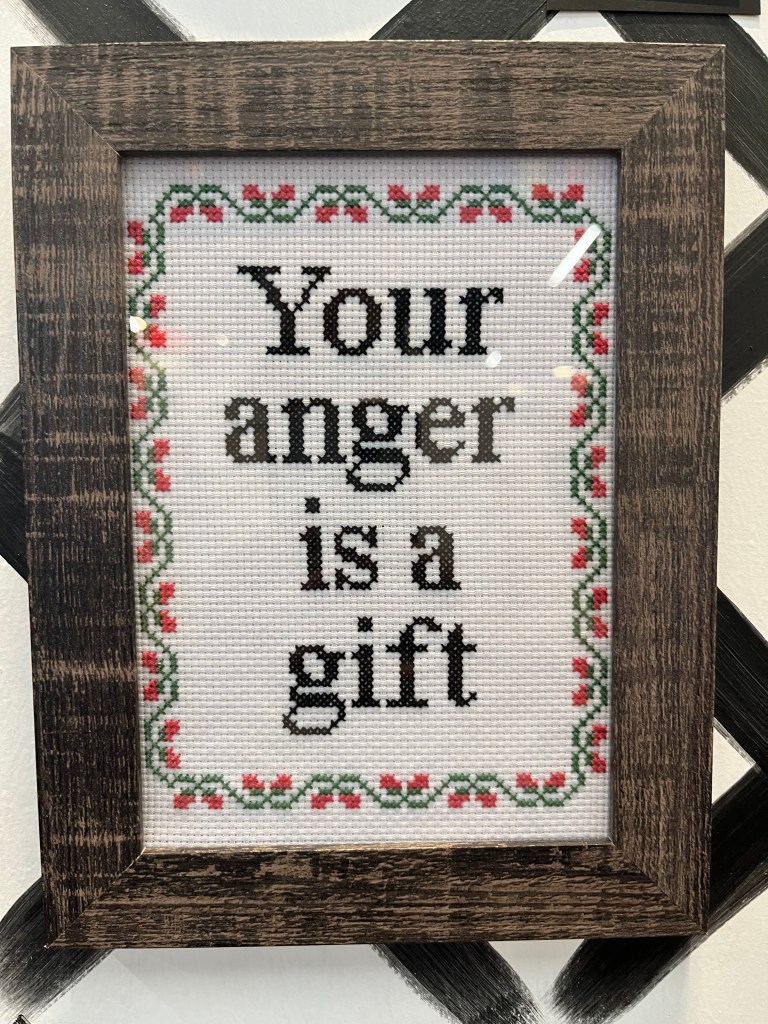
https://www.instagram.com/clarkstitch/
Photo credits: April Nance
Allowing, exploring, and understanding your anger takes time. Below are some of the books that I have read over the years about this topic, if you are interested in exploring more. As always, you can always contact me if you want to work together.
Permission to Feel by Marc Brackett
The Dance of Anger by Harriet Lerner
The Language of Emotions by Karla McLaren
Choosing Wholeness over Goodness: A Process for Reclaiming Your Full Self by Elise Loehnen and Courtney Smith
Are You Mad at Me? by Meg Josephson

 Soul Geography